When we look at objects around us, length, width, and height are the three fundamental measurements that define their dimensions. Length is the longest side of an object, width is the shorter horizontal side, and height represents the vertical measurement. Understanding these three dimensions is essential for everything from shipping packages to building furniture.
In our daily lives, we encounter numerous situations where knowing the correct dimensions of length, width, and height becomes crucial. For instance, when calculating the volume of a box, we multiply length × width × height to determine its cubic size. The standard dimensional notation follows this exact order (length × width × height), but many people find themselves confused about which measurement comes first. In this article, we’ll break down these concepts in simple terms, explore how to measure accurately, and learn the proper way to write and communicate dimensions. We’ll also examine how length and width apply to 2D objects, while all three measurements become necessary when working with 3D shapes.
What is length, width, and height?
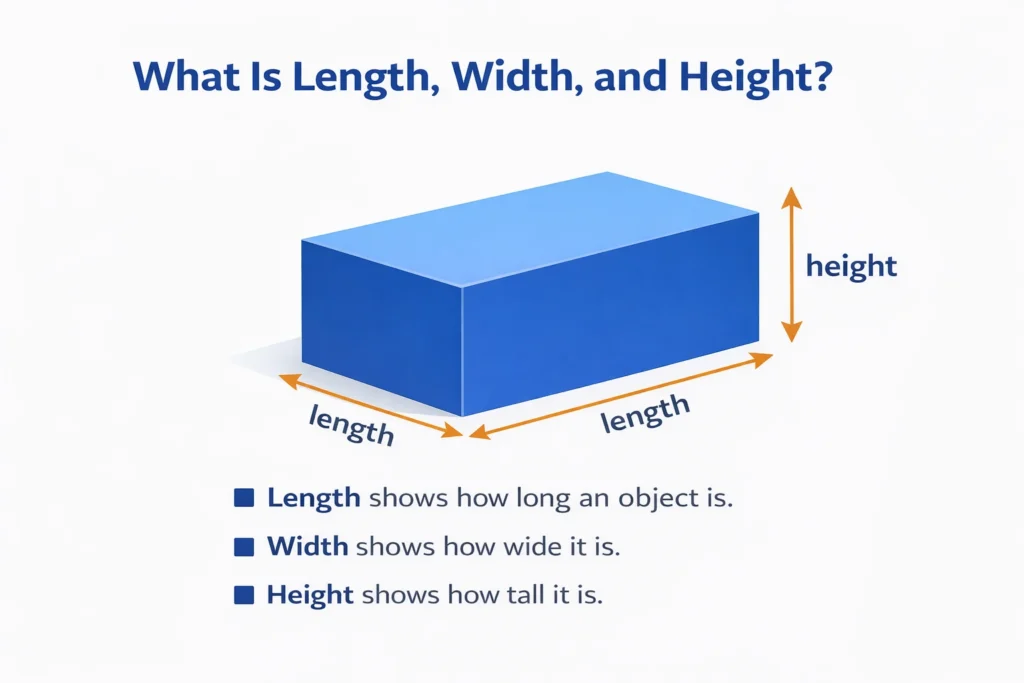
Dimensions serve as the foundational elements for describing the physical properties of objects. Length, width, and height together create a comprehensive understanding of an object’s size and shape in three-dimensional space. These measurements help us communicate precise specifications, especially in fields like manufacturing, architecture, and custom product packaging.
Length: the longest side
Length typically refers to the longest dimension of an object when measured from end to end. This measurement represents the greatest horizontal distance of an object and runs from one extreme point to another. According to mathematical conventions, length is traditionally defined as “the longer or longest dimension of an object”.
Furthermore, the concept of length has historical roots in our language – the words “along,” “long,” and “length” share etymological connections. This helps explain why we intuitively describe the extended portion of objects like roads or strings as their length.
Nevertheless, it’s worth noting that in certain specialized contexts, the definition can vary. For instance, in clothing measurements, length might refer to the vertical dimension of a garment rather than its longest side.
Width: the shorter horizontal side
Width measures the side-to-side distance of an object and is generally the shorter horizontal dimension. In geometric terms, specifically for rectangles, width is defined as the shortest side when used in conjunction with length. Some people occasionally refer to this measurement as “breadth,” particularly in formal or technical contexts.
Essentially, width represents how broad or wide an object appears from side to side. When we look at everyday examples, the width of a doorway describes how broad the opening is, whereas the width of a road tells us how many lanes it accommodates.
Despite these general conventions, the distinction between length and width can sometimes become ambiguous, especially when:
- The object is positioned at an angle
- The horizontal sides are nearly equal in measurement
- The context requires specific orientation rather than relative size
Height: the vertical measurement
Height introduces the third dimension to objects, transforming them from 2D to 3D shapes. This vertical measurement runs from the base of an object to its top, indicating how tall something stands. Unlike length and width, height is determined by orientation rather than relative size – it always measures upward against gravity.
Additionally, height creates the concept of depth in three-dimensional objects. In certain contexts, particularly when discussing containers or hollowed objects, we might use “depth” interchangeably with height to describe this vertical dimension.
The introduction of height is what fundamentally separates two-dimensional objects from three-dimensional ones. When we only have length and width, we’re describing flat shapes like rectangles or circles. However, once we add height, we create volume and enter the realm of three-dimensional objects like boxes, cylinders, and spheres.
Across various disciplines from architecture to shipping, these three dimensions work together to provide a complete description of physical objects. Understanding their proper definitions helps avoid confusion when measuring, describing, or designing anything from furniture to buildings.
2D vs 3D: When do we use all three dimensions?
Everything we encounter in our daily lives exists in either two or three dimensions. The distinction between 2D and 3D shapes fundamentally comes down to how many measurements we need to describe them fully. This understanding of dimensions is crucial for various applications, from custom product packaging to architectural design.
2D shapes: only length and width
Two-dimensional shapes exist solely on a flat plane and require just two measurements to define them completely: length and width. These flat figures have no thickness whatsoever, making them essentially mathematical concepts rather than physical objects in their purest form.
The key properties that define 2D shapes include:
- Two dimensions only: Length and width (or breadth)
- Area calculation: Measures the space covered on a plane
- Perimeter: The total distance around the edges
In mathematical terms, a point is considered zero-dimensional, while a line is one-dimensional as we can only measure its length. Once we add width to create a flat shape, we enter the realm of two dimensions.
Regular 2D shapes have equal sides and interior angles, such as squares and regular hexagons. In contrast, irregular 2D shapes feature unequal sides and varying interior angles.
3D shapes: include height
Three-dimensional objects introduce height (or depth) as the third dimension, transforming flat shapes into solid objects that occupy physical space. Unlike their 2D counterparts, 3D shapes have volume and can exist tangibly in the real world.
The defining characteristics of 3D objects include:
- Three dimensions: Length, width, and height (or depth)
- Volume calculation: The amount of space occupied
- Surface area: The total area of all surfaces
Most importantly, 3D objects can be physically manipulated and viewed from multiple angles. The addition of height creates the concept of depth, allowing objects to extend vertically against gravity.
Even if you don’t have actual 3D data, you can use 2D data to create 3D visualizations. For instance, 2D building footprints with height attributes can be extruded vertically to create 3D models of buildings. This technique is frequently used in geographical information systems and architectural design.
Examples of 2D and 3D objects
In our everyday environment, we encounter both 2D and 3D objects, though truly perfect 2D objects exist mainly as conceptual entities:
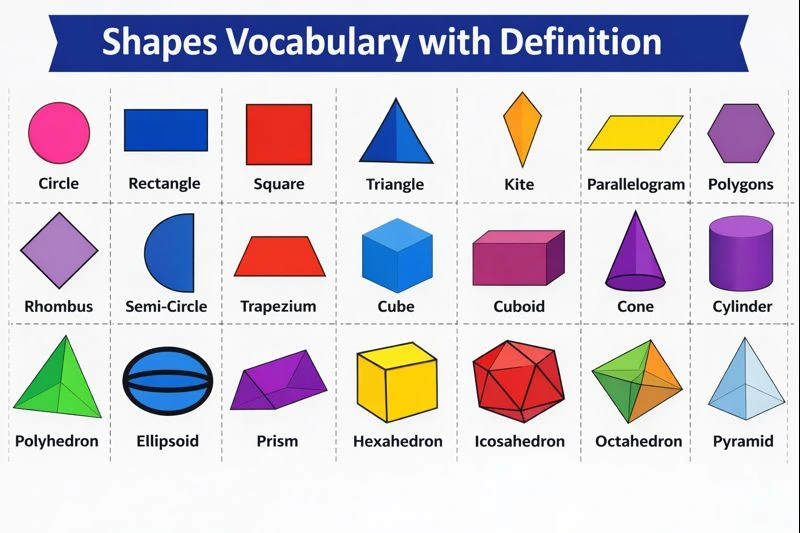
Common 2D shapes:
- Squares, rectangles, and parallelograms
- Circles and ovals
- Triangles (equilateral, isosceles, scalene)
- Polygons (pentagons, hexagons, octagons)
These 2D shapes primarily exist as representations on flat surfaces like paper, screens, or paintings. In fact, what we perceive as 2D objects (like a sheet of paper) actually have minimal thickness and are technically 3D objects, albeit very thin ones.
Common 3D shapes:
- Cubes and rectangular prisms (boxes)
- Spheres (balls)
- Cylinders (cans, pipes)
- Cones (ice cream cones, traffic cones)
- Pyramids
The distinction becomes particularly important in fields like manufacturing, shipping, and construction. For instance, when designing a box, knowing just the length and width of its base would be insufficient—you must consider its height to determine volume and capacity. Similarly, architects need all three dimensions to calculate building materials, while shipping companies require complete dimensional information to determine freight costs.
Understanding whether an object requires two or three dimensions for complete description helps us communicate specifications more effectively and select appropriate mathematical formulas for calculations related to area, perimeter, volume, and surface area.
How to measure length, width, and height
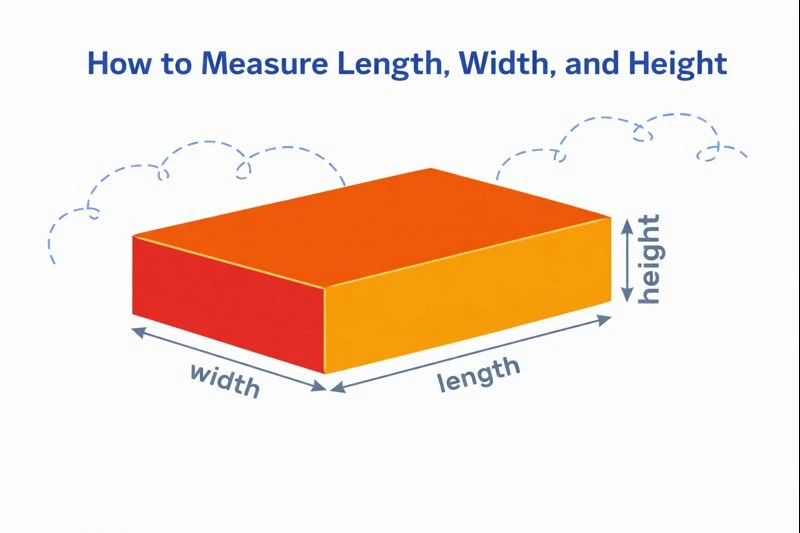
Measuring dimensions accurately is critical for countless everyday tasks, from creating custom product packaging to buying furniture for your home. Proper measurement techniques ensure you get exact dimensions, which leads to better planning and fewer costly mistakes.
Using a ruler or tape measure
The most common tools for measuring length, width, and height are rulers and tape measures, each designed for specific measurement scenarios. For smaller objects, a standard ruler works perfectly, offering precise markings in either inches or centimeters. Tape measures, on the other hand, provide flexibility for larger measurements and curved surfaces.
When using a tape measure, pay attention to its “hook” or “tang” the metal piece at the end. First thing to remember is that quality tape measures have a floating hook that moves slightly. This clever design ensures accuracy for both internal measurements (when pushed against an object) and external measurements (when hooked around an object). This small movement compensates for the thickness of the metal hook itself.
Measuring internal vs external dimensions
Understanding the distinction between internal and external dimensions is essential, particularly when working with containers or boxes. For this purpose, you need a different approach for each type of measurement.
To measure internal dimensions, position the box with its inside facing up and identify the score lines where the box folds to create panels. Measure between these score lines to get accurate interior dimensions. Most importantly, industry standards typically use internal measurements since products must fit based on available internal space.
External dimensions include the material thickness. For instance, a box made with 2mm thick material would have its external dimensions increased by approximately 0.4cm in each direction. Consequently, when boxes are overpacked and bulge, shipping dimensions must account for this additional size.
Tips for accurate measurement
To ensure precision when measuring length, width, and height:
- Measure multiple points — Walls and surfaces aren’t always perfectly straight, so take readings at different spots
- Create visual aids — For complex objects, sketch measurements as you go
- Consider material thickness — This affects both internal and external dimensions
- Use appropriate tools — Match your measuring tool to the task’s required precision
- Follow the orientation — Remember that height runs vertically from base to top
- Double-check — Verify measurements before making purchases or cutting materials
Be mindful of potential measurement errors, which fall into three categories: systematic errors (from instrument or temperature variations), random errors (from circumstances during measurement), and negligent errors (from inexperience or incorrect techniques).
Length × Width × Height: Calculating volume
The true power of understanding length, width, and height becomes apparent when we use these measurements to calculate volume. Once you’ve mastered measuring dimensions, you can determine how much space an object occupies or how much material it can hold.
Volume formula explained
Volume represents the three-dimensional space occupied by an object, measured in cubic units. To calculate the volume of a rectangular object (like a box or room), simply multiply its three dimensions together using the formula:
Volume = Length × Width × Height
This straightforward equation works for any rectangular prism. For instance, imagine a storage box measuring 5 inches long, 3 inches wide, and 4 inches high. Multiplying these dimensions (5 × 3 × 4) gives you 60 cubic inches of space.
Remember that all measurements must use the same unit before multiplication. Moreover, the resulting unit becomes cubic—if you measure in feet, your volume will be in cubic feet.
Table: Sample box dimensions and volumes
| Box Dimensions (Length × Width × Height) | Volume Calculation | Result |
| 10 cm × 10 cm × 10 cm | 10 × 10 × 10 | 1000 cm³ (1 L) |
| 15 in × 11 in × 5 in | 15 × 11 × 5 | 825 in³ |
| 5 m × 3 m × 2 m | 5 × 3 × 2 | 30 m³ |
Common units used in volume
Volume measurements typically appear in cubic units since they represent three-dimensional space. The SI base unit is cubic meter (m³), yet other measurements are often more practical for everyday use:
- Metric system: Cubic meters (m³), liters (L), milliliters (mL), cubic centimeters (cm³)
- US/Imperial system: Cubic feet (ft³), cubic inches (in³), gallons, quarts, fluid ounces
Helpful conversions to note include:
- 1 cubic meter (m³) = 1000 liters (L)
- 1 liter (L) = 1000 milliliters (mL)
- 1 milliliter (mL) = 1 cubic centimeter (cm³)
- 1 cubic foot (ft³) ≈ 28.32 liters
- 1 gallon (US) ≈ 3.79 liters
Indeed, understanding volume calculations proves invaluable for various applications, from determining shipping costs to planning storage solutions. For businesses involved in custom product packaging, calculating accurate volumes ensures proper material usage and efficient shipping.
Understanding dimension order and notation
Properly communicating dimensions requires understanding the standard conventions for writing them. In fields ranging from shipping to custom product packaging, knowing the correct order and notation prevents costly misunderstandings and ensures everyone speaks the same dimensional language.
Standard order: Length × Width × Height
The industry standard for dimension notation follows Length × Width × Height (L×W×H). This sequence represents a logical progression: length (the longest horizontal side), width (the shorter horizontal side), and height (the vertical measurement). Following this convention is particularly important in the shipping and packaging industries, where consistency prevents confusion. Ultimately, maintaining this standard sequence ensures that everyone interprets dimensional specifications correctly.
What comes first: length or width?
Length typically comes before width in most standard measurement conventions. Primarily, length represents the longest dimension when viewed from the front or top. Meanwhile, width indicates the shorter horizontal measurement perpendicular to length. Nevertheless, several factors contribute to confusion about this order, especially with rectangular objects having similar dimensions. Obviously, in some specialized contexts like graphics design, the width might precede height (W×H) for visual orientation.
How to write dimensions correctly
For clear dimension notation, use the multiplication symbol (×) rather than the letter “x”. Undeniably, proper notation includes spaces between values and their units (12 in; 30 cm). Henceforth, maintain consistency throughout your documents by using one unit system (inches, centimeters, or meters). Moreover, when precision matters, explicitly label dimensions (L×W×H) rather than listing numbers alone.
Conclusion
Understanding the fundamental concepts of length, width, and height allows us to accurately describe the world around us. These three dimensions serve as the building blocks for everything from simple household measurements to complex architectural designs. Consequently, mastering these concepts proves invaluable for countless practical applications.
Throughout this article, we’ve seen how length represents the longest side of an object, width indicates the shorter horizontal measurement, and height describes the vertical dimension. Additionally, we’ve explored the critical distinction between 2D shapes that require only length and width versus 3D objects that need all three measurements to be fully described.
Accurate measurement techniques remain essential for everyday tasks. Whether using a ruler for small objects or a tape measure for larger items, precision matters. Furthermore, knowing how to calculate volume by multiplying length × width × height gives us the power to determine how much space an object occupies or how much material it can hold.
The standard notation order (L×W×H) exists for a reason—consistency helps prevent costly misunderstandings across industries. Therefore, following this convention ensures clear communication when specifying dimensions for shipping, manufacturing, or purchasing decisions.
These dimensional concepts might seem basic at first glance, yet their proper application touches nearly every aspect of our lives. From determining if furniture will fit through a doorway to calculating shipping costs, dimensional awareness saves time, money, and frustration. Most importantly, once you grasp these fundamental principles, you’ll navigate spatial challenges with confidence and precision.
Key Takeaways
Understanding dimensions is essential for everyday tasks, from shipping packages to buying furniture. Here are the core concepts you need to master:
- Length is the longest side, width is the shorter horizontal side, and height is the vertical measurement – this standard definition applies to most objects and situations.
- Use the standard notation L×W×H when writing dimensions – this industry convention prevents costly misunderstandings in shipping and manufacturing.
- Calculate volume by multiplying length × width × height – this simple formula works for any rectangular object and helps determine space or capacity.
- 2D shapes need only length and width, while 3D objects require all three dimensions – understanding this distinction is crucial for accurate measurements and calculations.
- Measure multiple points and use appropriate tools – walls aren’t always straight, so take readings at different spots and match your measuring tool to the required precision.
These fundamental principles form the foundation for spatial awareness in construction, design, packaging, and countless daily activities. Master these basics, and you’ll handle dimensional challenges with confidence and avoid expensive measurement mistakes.
FAQs
How do you determine which measurement is length, width, or height?
Length is typically the longest side of an object, width is the shorter horizontal side, and height is the vertical measurement from base to top. For most objects, this standard definition applies, though some specialized contexts may have different conventions.
Why is the order of dimensions important?
The standard order for dimensions (length × width × height) is crucial for clear communication, especially in industries like shipping and manufacturing. Following this convention helps prevent misunderstandings and ensures everyone interprets dimensional specifications correctly.
How do you calculate the volume of a rectangular object?
To calculate the volume of a rectangular object, multiply its length, width, and height together. The formula is Volume = Length × Width × Height. Remember to use the same unit of measurement for all dimensions to get the correct result in cubic units.
What’s the difference between 2D and 3D measurements?
2D shapes require only length and width measurements, as they exist on a flat plane. 3D objects need all three dimensions (length, width, and height) to be fully described, as they occupy physical space and have volume.
What are some tips for accurate measurement?
For precise measurements, use appropriate tools like rulers or tape measures, measure multiple points on an object, consider material thickness, and double-check your readings. It’s also important to be aware of internal versus external dimensions, especially when dealing with containers or boxes.